
Eye-tracking Glasses
Visual attention in real settings
Eye-tracking glasses make it possible to study consumers' visual behavior in natural environments: retail, public spaces, restaurants, transport, events or even at home.
Unlike lab studies, this technology allows measurement in real settings, capturing visual attention in everyday situations without altering the experience.
Technology
At Databrain we work with the Pupil Labs Neon, a state-of-the-art system that combines:
- High accuracy in recording eye movements.
- Light weight and ergonomic design for comfort throughout the study.
- Transparent data with real-time streaming.
- Multimodal compatibility, integrating with EEG, GSR and other biometric sensors.
where the gaze lands.
how long it stays on a stimulus.
the order in which elements of the environment are explored.
dynamic heatmaps showing how attention is distributed.
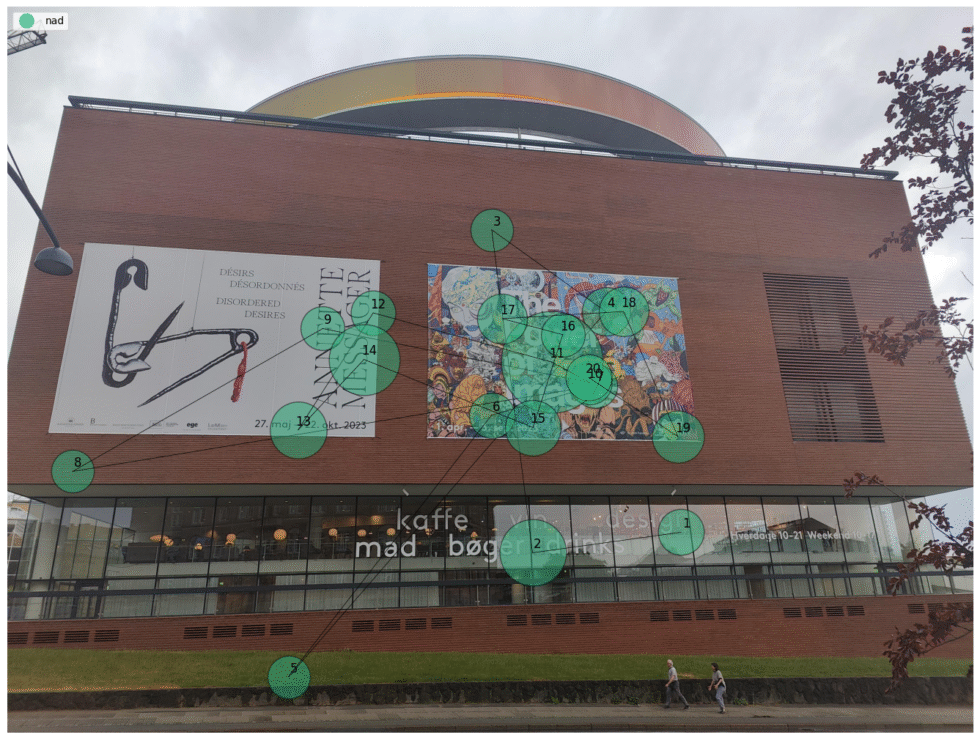
gaze tracking on moving objects in the real environment (shelves, products, signage).
+ Industry standardthe percentage of people who actually look at each element of the environment.
+ Industry standardMarket Research Applications
identifying which products stand out on the shelf and which go unnoticed.
assessing whether signage and street messaging actually capture attention.
analyzing how consumers read menus and choose options.
understanding attention at events, brand activations or urban journeys.
Eye-tracking glasses are also a powerful tool for user experience (UX) research
- Evaluating interfaces in natural settings (mobility apps or interactive kiosks, for instance).
- Analyzing how devices and digital products are used in real conditions.
- Identifying visual friction in purchase and navigation flows outside the lab.

Analysis capabilities
Beyond capture: how we work with gaze data to turn it into actionable insights.
Live streaming
Watch the participant's gaze in real time during the study, for qualitative reads on the spot.
Gaze replays
Review the visual journey as many times as you need, individually or aggregated across participants (gaze replays).
Gaze mapping
Aggregate multiple participants' gaze onto a reference scene — locally or in the cloud — to scale large studies.
Automatic AOI generation
Create and track areas of interest across the video automatically, saving hours of manual annotation.
Automatic quality control
Calibration and recording validation that keep noisy data out, before and during the study.
Flexible data export
Export X,Y coordinates, AOI metrics, pupillometry and more in an open format, ready for custom analysis.
Frequently asked questions
How do eye-tracking glasses work?
They shine near-infrared light toward the pupils, producing reflections on the pupil and cornea. Infrared cameras around the lenses record those reflections and compute where the person is looking, while they move freely.
What can eye-tracking glasses measure?
They reveal how people look and interact in the real, dynamic world: where attention lands, in what order and for how long. They take visual attention measurement out of the lab and into everyday settings.
When should you use eye-tracking glasses?
When screen-based eye tracking or webcam is not enough: whenever the participant has to perform a real-world task — walking a shelf, using a product, moving through a physical space.
Are they invasive or uncomfortable for participants?
No. With the Pupil Labs Neon they are light and ergonomic, much like ordinary glasses, and let people move naturally without altering the experience.
How do they differ from screen-based eye tracking?
Glasses measure attention in real, moving environments; screen-based eye tracking measures in front of a fixed screen (websites, apps, video). They are complementary, depending on the study's goal.
The complete picture with Databrain
Combined with EEG, GSR, ECG or facial coding, eye-tracking glasses enable an integrated analysis that ties together visual attention, emotion and cognitive load, giving brands a deep and actionable understanding of consumer behavior.
Book a demoPublicaciones científicas con Gafas de Eye-Tracking
Contact
Let science make your advertising work harder.
Fill in the form and one of our specialists will get in touch to show you how Databrain can transform your advertising.
Thanks for reaching out!
We will be in touch shortly to arrange a personalized demo.
